

The Impossible Business Model of OpenAI
The technology works. The economics don’t. And we’ve seen this movie before.

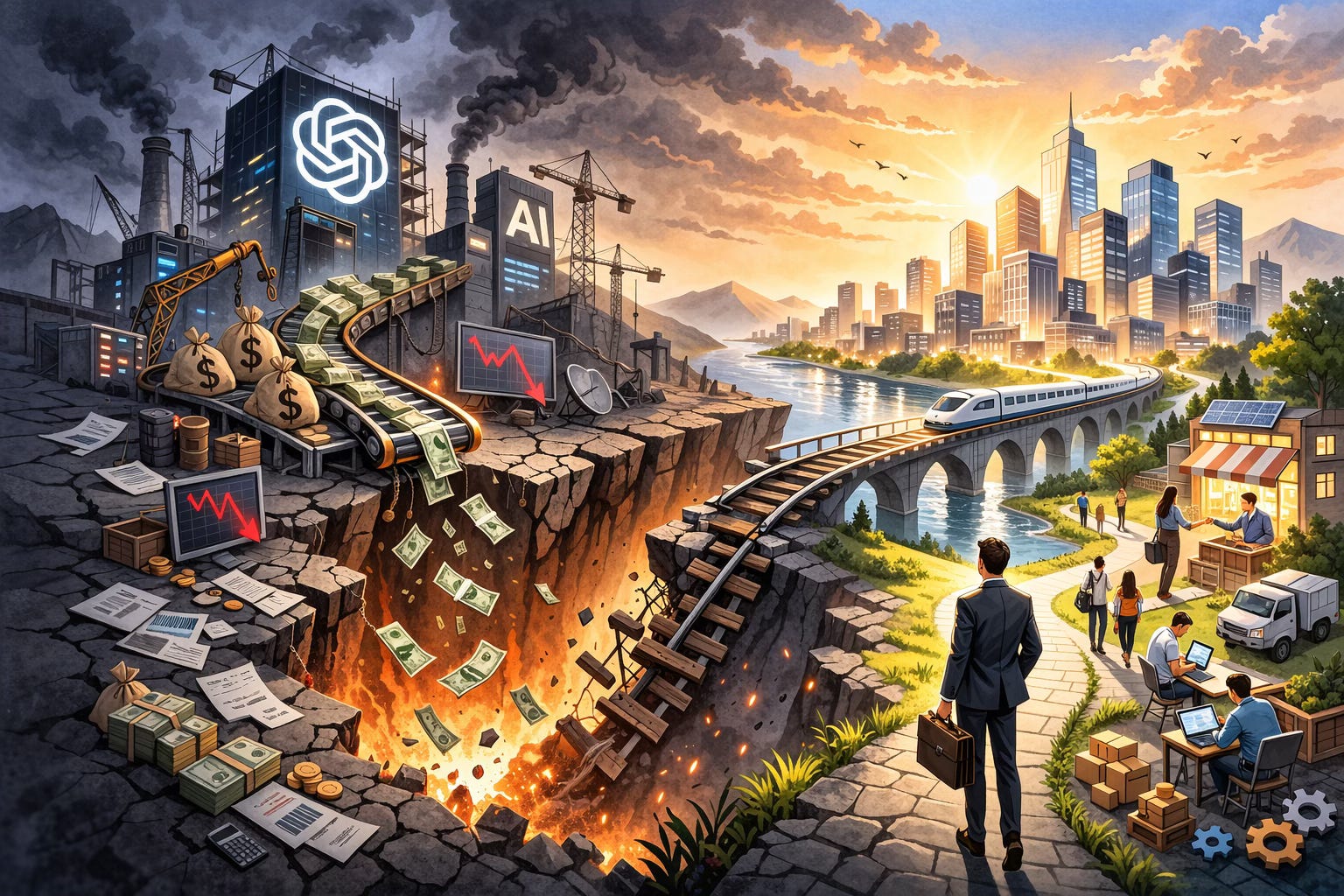
A few days ago, Bloomberg reported that OpenAI is finalizing a funding round expected to exceed $100 billion1. It would value the company at more than $850 billion. It would also be the largest private funding round in history, more than double the previous record, which OpenAI itself set less than a year ago. For context: Meta, which serves 3.6 billion daily users and generates over $200 billion in annual revenue, is worth roughly twice that. OpenAI generates around $12 billion and is still losing billions. This should raise questions. It doesn’t seem to.
When ChatGPT launched in late 2022, it felt like the beginning of a new era. And it was. But like most people, I assumed that the companies building the intelligence would be the ones to capture the value. OpenAI, Anthropic, Google DeepMind: these were the architects of something genuinely transformative. Surely they would be the winners.
I was wrong. The technology is extraordinary. The business model is not. And if you look at the history of infrastructure revolutions, this shouldn’t come as a surprise. The builders never win. 19th century railroad track-layers in America went bankrupt while Rockefeller built an empire on cheap rail. The telecom companies that laid fibre optic cable in the 1990s destroyed trillions in equity while Google, Netflix, and Amazon built trillion-dollar businesses on infrastructure they never paid for. The same pattern is now playing out in AI, and it doesn’t stop at the hardware layer. It goes all the way up to the models themselves.
The Three-Month Advantage
A foundation model company is, at its core, a business that trains large AI models and sells access to them. OpenAI sells access to GPT. Anthropic sells access to Claude. Google sells access to Gemini. When you use ChatGPT or call an API, you’re renting time on a model that cost hundreds of millions, sometimes billions, of dollars to build.
The problem is that the advantage this investment buys is shrinking to almost nothing.
Research published in January 2026 by MIT found that open-source models (models whose designs are published freely for anyone to use and modify) now reach roughly 90% of the performance of the best proprietary models at the moment those proprietary models are released. The remaining gap closes within 13 weeks. A year earlier, that catch-up window was 27 weeks2. On one widely used benchmark, the gap between open-source and closed models shrank from 17.5 to 0.3 percentage points in a single year3.
Think about what that means for a company that just spent billions training a new model. The moment it launches, it has at best three months before freely available alternatives offer comparable performance at a fraction of the cost: 87% less to run, according to the same MIT research4. And there is no brand loyalty to fall back on. When Anthropic released Claude 4 Sonnet, it captured 45% of enterprise users in a single month. The previous version dropped from 83% market share to 16%5. Users don’t switch reluctantly over years, the way they do with enterprise software. They switch in a week.
This is about to get worse. DeepSeek, a Chinese AI lab, is expected to release its V4 model imminently. It is open-source. Internal benchmarks reportedly show it outperforming both Claude and GPT on coding tasks. It has 1 trillion parameters and a million-token context window. It will run on consumer-grade hardware. And based on DeepSeek’s track record, it will cost a fraction of what Western labs spend to achieve comparable results6. DeepSeek’s previous model, R1, was reportedly trained for under $6 million. Even if that figure is significantly understated, it reveals the direction of travel7.
Every billion spent training a frontier model buys roughly three months of meaningful advantage. That is not a business model. That is a subsidy.
The Agentic Mirage
If selling access to the model itself doesn’t work, the next argument is that foundation model companies will capture value by building AI agents: software that can act autonomously, complete tasks, make decisions. This was supposed to be the moat: building agents is hard, it requires deep integration with the model, and only the companies that train the models can do it well.
In late January 2026, an Austrian developer named Peter Steinberger released an open-source project called OpenClaw. It is an AI agent that runs on your own devices and connects to WhatsApp, Telegram, Slack, email, your calendar, your browser, essentially anything you use. It can manage your inbox, schedule meetings, browse the web, write and execute code, and take actions on your behalf. It works with any model: Claude, GPT, DeepSeek, or a model running locally on your laptop8.
Within weeks, OpenClaw had over 150,000 stars on GitHub, making it one of the fastest-growing open-source projects in history9. Users reported agents that negotiated car purchases over email while they slept, filed legal rebuttals to insurance companies, and built websites from a phone. Is it secure? Not really. Cybersecurity researchers have raised serious alarms about the permissions it requires10. Is it production-ready for enterprises? Absolutely not. But that isn’t the point.
The point is that agent orchestration is software. And software, in the age of AI-assisted development, is extraordinarily cheap to build. One person built a functional — albeit imperfect — agentic AI system in weeks. Imagine what ten AI-enhanced developers could do. Or a hundred. Any software company with domain expertise can build agent orchestration on top of commodity open-source models. The foundation model companies have no structural advantage here. They have disrupted themselves.
This matters because it collapses the last plausible argument for why foundation model companies should command enormous valuations. The model itself is a commodity that gets replicated in weeks. The agent layer is software that can be built by anyone. What remains?
The Impossible Maths
What remains is a staggering amount of investor money that needs a return.
OpenAI has raised approximately $58 billion and is currently seeking another $100 billion, which would value the company at over $800 billion11. Anthropic has raised nearly $64 billion at a $380 billion valuation12. Together, these two companies alone have absorbed more than $120 billion in venture capital and strategic investment.
To understand why this is a problem, you need to understand how venture capital works. Investors don’t put money into startups hoping for a modest return. The economics of the industry require that the biggest bets deliver returns of at least 3 to 5 times the invested capital, because most investments in a fund fail entirely. For a late-stage investor in OpenAI, a 3× return on a $300 billion valuation means the company must be worth roughly a trillion dollars at exit. At the kind of revenue multiples that mature technology companies trade at, say 10 times annual revenue, that requires $100 billion in annual revenue.
For context, that is roughly what Nvidia generated in 2025, on the back of what amounts to a near-monopoly over the most explosive hardware cycle in technology history13.
Can OpenAI get there? The company’s annualized revenue is reportedly around $20 billion, growing fast14. But the cost of getting there is immense. OpenAI projects $14 billion in operating losses for 2026, roughly three times worse than 2025. Internal documents show cumulative losses of $44 billion through 2028, with profitability not expected until 2029 at the earliest15. Spending projections through 2029 total approximately $115 billion16. The company has committed $300 billion to Oracle for computing power and $38 billion to Amazon’s cloud, the largest cloud contracts ever signed17.
And all of this must generate returns in a market where the price of the product is collapsing. API pricing for frontier-level AI performance has fallen by roughly 99.7% in two years18. The equivalent of GPT-4 performance, which cost $30 per million tokens in March 2023, costs roughly $0.40 today. Every time a DeepSeek or Meta releases an open-source model, the price ceiling drops further. OpenAI’s own revenue growth depends on slashing prices to stay competitive, which undermines the revenue trajectory that justifies the valuation that justifies the investment.
Anthropic faces the same bind. Despite reaching $14 billion in annualised revenue (an extraordinary achievement), the company’s gross margins were negative as recently as 2024, and even optimistic projections put them well below the 75-80% margins that mature software companies enjoy19. The company will need to keep raising billions to fund operations, further diluting the returns available to earlier investors.
Compare this to the enterprise software companies that everyone assumes AI will destroy. Veeva Systems, a cloud platform for the pharmaceutical industry, generates $3.2 billion in revenue with 45% operating margins and over a billion dollars in free cash flow20. CrowdStrike, a cybersecurity platform, runs at 81% gross margins. Adobe produces $10 billion in annual free cash flow. These companies fund their own operations and return capital to shareholders. Foundation model companies consume capital from external investors to fund operations that may or may not become profitable within the decade.
AI is clearly disrupting the pricing power of enterprise software. The era of charging premium rents on business logic is ending. But even a repriced SaaS company has something foundation model companies do not: sticky customers, decades of embedded integrations, regulatory moats, and a business model that generates cash. Switching from Salesforce means migrating every downstream integration, retraining every workflow, rebuilding every reporting pipeline. Switching from one AI model to another means changing one line of code. The companies everyone is writing off are in better structural shape than the companies everyone is betting on.
Where the Value Actually Lands
So if the model is a commodity and the agent layer is replicable software, who wins?
The answer is the same answer it has always been across every infrastructure cycle in economic history. The people who built the railway tracks went bankrupt. The people who used the cheap rail to build Standard Oil and Sears became the wealthiest of their era. The people who laid fibre optic cable in the 1990s destroyed $2.8 trillion in shareholder value. Google, Netflix, and Amazon built trillion-dollar businesses on infrastructure they never paid for.
The value will go to whoever combines AI with deep domain knowledge, proprietary data, and industry-specific expertise. Whoever deploys it through applications that solve real problems in complex, regulated environments. Not general-purpose chatbots. Not agent platforms that any developer can replicate. Applications where the business logic, the compliance requirements, the institutional knowledge, and the customer relationships create switching costs that a better model cannot dissolve.
What survives is specification — the deep knowledge of what the software should do, held by the people who understand the business. The product expert who spent fifteen years encoding regulatory workflows can now rebuild core logic on open-source infrastructure in months. The value was never in the platform. It was in the knowledge. And it was never in the model. It is in what you build on top of it.
Someone Will Hold the Bag
I use Claude every day. I used it to help research, structure, and refine this article. The technology is, without qualification, extraordinary. It is almost certainly the most important general-purpose technology since electricity.
But extraordinary technology and extraordinary business are not the same thing. The electrical grid was transformative. The companies that built it went bankrupt. The internet changed civilisation. The companies that laid the cable destroyed trillions in equity. In both cases, the value went to whoever built the best applications on top of infrastructure that someone else had paid for, and that everyone could access.
And here is the deeper pattern. Electricity itself became a commodity. Nobody chooses their power company because the electricity is higher quality or enables them to do different things. You choose on price and reliability. The electrons are identical. AI models are converging on the same dynamic. The performance gap between providers is shrinking to near zero. The switching cost is negligible. The product is becoming interchangeable. When that happens to any industry, margins collapse to commodity levels, and value migrates to whoever builds the best products on top of the commodity input. That is what is happening to foundation models right now.
Until last month I was a ChatGPT user. Today I use Claude. The switch took ten minutes. I didn’t think twice. Next month, if DeepSeek V4 delivers what the benchmarks suggest, or if Google’s Gemini pulls ahead, or if some open-source model running locally on my laptop is good enough — I will switch again. I will not hesitate. I will not look back. I have zero loyalty to any foundation model company, and neither does anyone else. The switching cost is changing one line of code, or downloading a different app.
Multiply me by a billion users, and you have the business model problem in a single image.
Now zoom out. OpenAI has absorbed nearly $60 billion from investors including SoftBank, Microsoft, pension funds, and sovereign wealth funds. Anthropic has taken in $64 billion from a similar cast. Much of this capital originates from retirement funds, endowments, and sovereign wealth vehicles that manage savings for hundreds of millions of ordinary people21. These investments need returns that the underlying economics — collapsing pricing, no switching costs, three-month advantages — may never deliver.
The railroads at least left track behind. The fibre at least carried traffic eventually.
What does a deprecated model leave behind?
Disclaimer: I do NOT hold any positions — long or short — in any of the companies listed in this article.
Bloomberg, “OpenAI Funding on Track to Top $100 Billion in Latest Round,” February 19, 2026. Valuation expected to exceed $850 billion. Key investors include Amazon (~$50 billion), SoftBank (~$30 billion), Nvidia (~$20 billion), and Microsoft.
Nagle and Yue, “The Latent Role of Open Models in the AI Economy,” MIT Initiative on the Digital Economy / Linux Foundation, January 2026. Coverage.
Nagle and Yue, MIT / Linux Foundation (January 2026): open-source inference pricing $0.23 vs $1.86 per million tokens for closed models (87% cheaper). Coverage.
Menlo Ventures, “2025 Mid-Year LLM Market Update,” November 2025.
The Information via Reuters, “DeepSeek to launch new AI model focused on coding in February,” January 2026. Internal benchmarks claim superior coding performance; open-source release under Apache 2.0 expected. Architecture details published in DeepSeek research papers (mHC, December 2025; Engram, January 2026).
DeepSeek R1 technical report, January 2025. GitHub. The $6 million figure refers to the reported training compute cost; full R&D investment was likely significantly higher.
OpenClaw (formerly Clawdbot/Moltbot), created by Peter Steinberger. GitHub; CNBC coverage, February 2026.
CrowdStrike, “What Security Teams Need to Know About OpenClaw”, February 2026. Bitsight reported over 30,000 exposed instances within two weeks of launch.
OpenAI total funding approximately $57.9 billion per Tracxn/PitchBook data; $100 billion round at $830 billion valuation reported by Bloomberg, February 19, 2026, and TechCrunch, December 2025.
Anthropic raised $30 billion Series G at $380 billion valuation, February 2026. Total funding approximately $64–67 billion. CNBC; Crunchbase.
Nvidia FY2025 revenue $130.5 billion. Nvidia Earnings Release, February 2025.
OpenAI annualised revenue approximately $19–20 billion. CNBC, February 2026; SF Examiner, January 2026.
Wall Street Journal, reporting on OpenAI internal documents projecting $14 billion operating loss in 2026 and cumulative losses of $44 billion through 2028. Referenced in multiple outlets including TapTwice Digital.
OpenAI spending projections approximately $115 billion through 2029. Originally reported by The Information, September 2025; Fortune; CNBC. Annual breakdown: $17 billion (2026), $35 billion (2027), $45 billion (2028).
Oracle $300 billion computing contract reported by Reuters, September 2025. Amazon $38 billion AWS deal reported by TechCrunch.
Inference cost decline calculated from GPT-4 launch pricing (March 2023) to equivalent performance pricing by mid-2025. J.P. Morgan Asset Management; Artificial Analysis. Epoch AI analysis found price declines accelerating to 200× per year.
Anthropic gross margins negative 94% to 109% in 2024; revised 2025 target of 40% after inference costs exceeded projections by 23%. Anthropic annualised revenue $14 billion as of February 2026. Anthropic announcement.
Veeva Systems FY26 revenue guidance $3.17 billion; 45% non-GAAP operating margins; $1.07 billion free cash flow. CrowdStrike 81% gross margins. Adobe approximately $10 billion annual free cash flow. Figures from company earnings reports.
OpenAI investors include SoftBank ($30 billion), Microsoft, Nvidia, pension-adjacent funds (Fidelity, T. Rowe Price), and sovereign wealth vehicles (MGX). Anthropic investors include GIC (Singapore sovereign wealth fund), Ontario Teachers’ Pension Plan, Qatar Investment Authority, and similar institutional capital. Per SEC filings, Tracxn, and company announcements.
Your railroad analogy is exactly right. But I'd push it one layer deeper. Between the model builders going broke and the application builders getting rich, there's a middle layer quietly making fortunes: the inference providers. Together AI at $3.5 billion, Fireworks at $3.4 billion, OpenRouter processing 30 trillion tokens a month. The pickaxe sellers in this gold rush are the ones hosting commodity models, not building them. I traced the full economics of who profits when models are free: https://medium.datadriveninvestor.com/who-profits-when-ai-models-are-free-b71ae03f4167